Here's a thought experiment we run on the skeptical: imagine a new drug hits the market tomorrow. Clinical effects: sharpens memory and decision-making, strengthens immune response, accelerates muscle repair, stabilizes mood, improves metabolic health, and associates with lower risk of nearly every major disease of aging. One dose nightly. Zero cost. The line would circle the pharmacy for miles — and the drug, of course, is sleep, and most of the line is currently taking two-thirds of the prescribed dose and wondering why they feel like this.
An honest confession opens this one: we sell recovery services, and sleep outranks everything we sell. It outranks everything anyone sells. Here's the case, and then the supporting role we can honestly claim.
What the night shift actually manufactures
Sleep isn't rest — it's production, run in stages, each with a job your daytime health depends on: deep sleep is the heavy industry — growth hormone released, tissue repaired, immune munitions provisioned, and the brain's remarkable glymphatic system running its cerebrospinal rinse cycle, physically clearing the day's metabolic waste (including the protein debris implicated in long-term neurodegeneration — the reason chronic short sleep keeps appearing in dementia risk research). REM is the cognitive shift — memory consolidated, emotion regulated, the day's learning filed. Cut the night short and you don't lose rest proportionally — you lose whole production runs, because the stages are scheduled across the full night. The 5.5-hour sleeper isn't getting 70% of the benefit. They're skipping entire departments.
If sleep were a pill, it would be the best-selling drug in history. It's free, and America takes two-thirds of the dose.
The underdosing epidemic (and its favorite lie)
The lie is "I'm fine on six" — and the research dismantles it from an uncomfortable angle: sleep deprivation degrades the self-assessment machinery itself, so chronic short-sleepers adapt to impairment they can no longer perceive (the same trap as the all-nighter's "I'm actually fine"). True genetic short-sleepers exist and are rare enough to be a research curiosity; the other 95% claiming the title are running the depletion checklist's first cause and calling it a personality. The costs compound quietly across every system this blog covers — the immune dips, the muscle account's stalled deposits, the NAD⁺ loop, the metabolic drift — which is precisely why sleep sits atop every serious healthspan podium: it's the intervention every other intervention depends on.
Redosing (the fundamentals, ranked)
The evidence-ranked protocol, gadget-free: consistency first — same sleep and wake window daily, weekends included; the circadian machinery trains on rhythm and runs everything else on it. The alcohol honesty — the great deep-sleep thief, flattening exactly the stages that matter most (the nightcap trades sedation for production). The caffeine embargo — 8+ hours before bed, no exceptions your adenosine receptors will honor. Cool, dark, boring room. And the supporting dependencies — our honest lane: magnesium status supports sleep quality (the Myers' calm, the most-depleted mineral's night job) and hydration affects depth (dehydrated sleep runs measurably shallower — the Florida deficit reaches into the night). We supply the dependencies. The headliner remains free, nightly, and un-replaceable by anything in our bag or anyone else's.
The supporting act
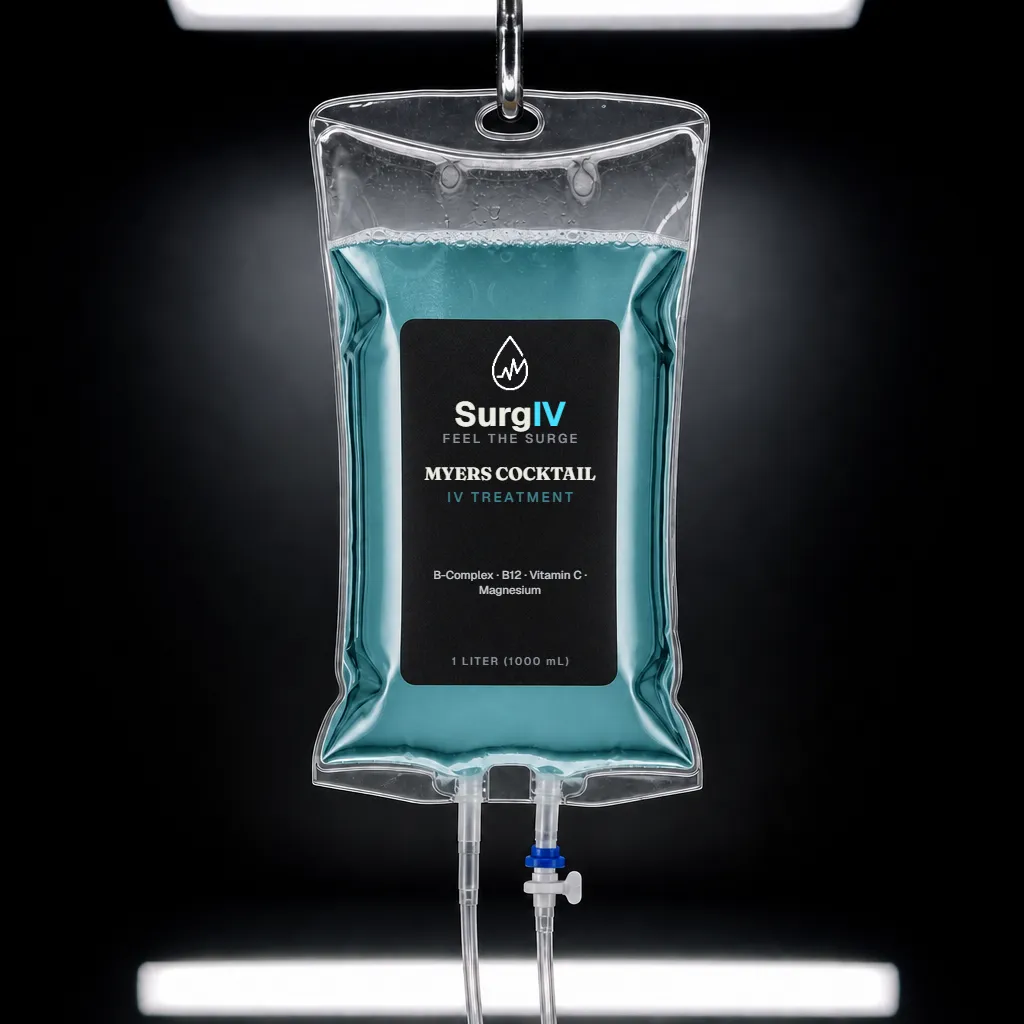
Myers Cocktail $249
Magnesium and hydration — two of sleep quality's quiet dependencies, fully supplied.
B-Complex · B12 · Vitamin C · Magnesium
The confession, completed
So there it is, from a recovery company: the best thing on our menu isn't on our menu. Take the full dose of the free drug — then, for the depletion the days still deliver, the supporting cast knows its role and shows up to your couch. The line for the pharmacy starts at your own bedtime, tonight, and moves fastest for the people who stop bragging about skipping it.
This article is for general education and is not medical advice. IV therapy at SurgIV is administered by registered nurses under physician-written protocols, with a health screening before your first visit. Talk to your doctor about what is right for you.