
The question arrives from every training client eventually, usually phrased like a client we'll call Marcus, 44, masters swimmer, put it mid-drip: "Straight answer — is this bag making me faster, or just making me feel better about Tuesdays?"
The straight answer deserves its own article, because NAD⁺-for-performance is where honest mechanism and gym-marketing hype diverge hardest. Here's the line, drawn carefully.
What the molecule can't do (clearing the hype first)
NAD⁺ is not a performance enhancer in any direct sense — no acute strength boost, no speed effect, nothing a stopwatch sees on session day. The clinics marketing it as legal-edge magic are overreaching per usual. What it is: the coenzyme funding mitochondrial ATP production — the energy economy every training session draws against and every recovery night rebuilds from. Restoration doesn't add horsepower. It refills the fuel account the horsepower runs on — which matters exactly as much as that account was depleted, which for the over-35 training population is: considerably.
"Is this making me faster, or making me feel better about Tuesdays?" — the right question, and the answer is the second one, which turns out to produce the first one.
The mechanism's actual promises
Follow the biochemistry to its honest conclusions: restored NAD⁺ supports work capacity (mitochondria producing energy at funded rates — training sessions costing less systemically), recovery throughput (the overnight rebuild is metabolic work running on the same coenzyme — the widening-window story's machinery), and training frequency sustainability — the over-40 headline, because the thing that actually erodes masters athletes isn't single-session performance but the recovery math that turns four weekly sessions into two. The member reports track the mechanism with satisfying precision: sessions feeling 'cheaper,' bounce-back accelerating, blocks sustaining — capacity-and-recovery effects, never stopwatch magic. Marcus's own answer arrived at week six: his interval times hadn't jumped; his Thursday times stopped collapsing — "same swimmer, more Tuesdays" — which across a season is precisely how masters PRs actually happen.
The athlete's configuration
How the training population runs it: the Surge as the delivery vehicle (500mg NAD⁺ inside the full recovery formula — the aminos, magnesium and hydration the training week also spent), scheduled per the timing playbook — rest days or post-heaviest-block, given NAD⁺'s longer infusion; monthly as the base rhythm, biweekly through heavy blocks per the fade-point calibration. Stack compatibility: sits upstream of creatine (phosphagen system) and protein (building material) without interaction — the energy economy underneath the standard stack. And the standing honesty: the molecule funds the doing; the doing remains yours. No bag has ever swum an interval.
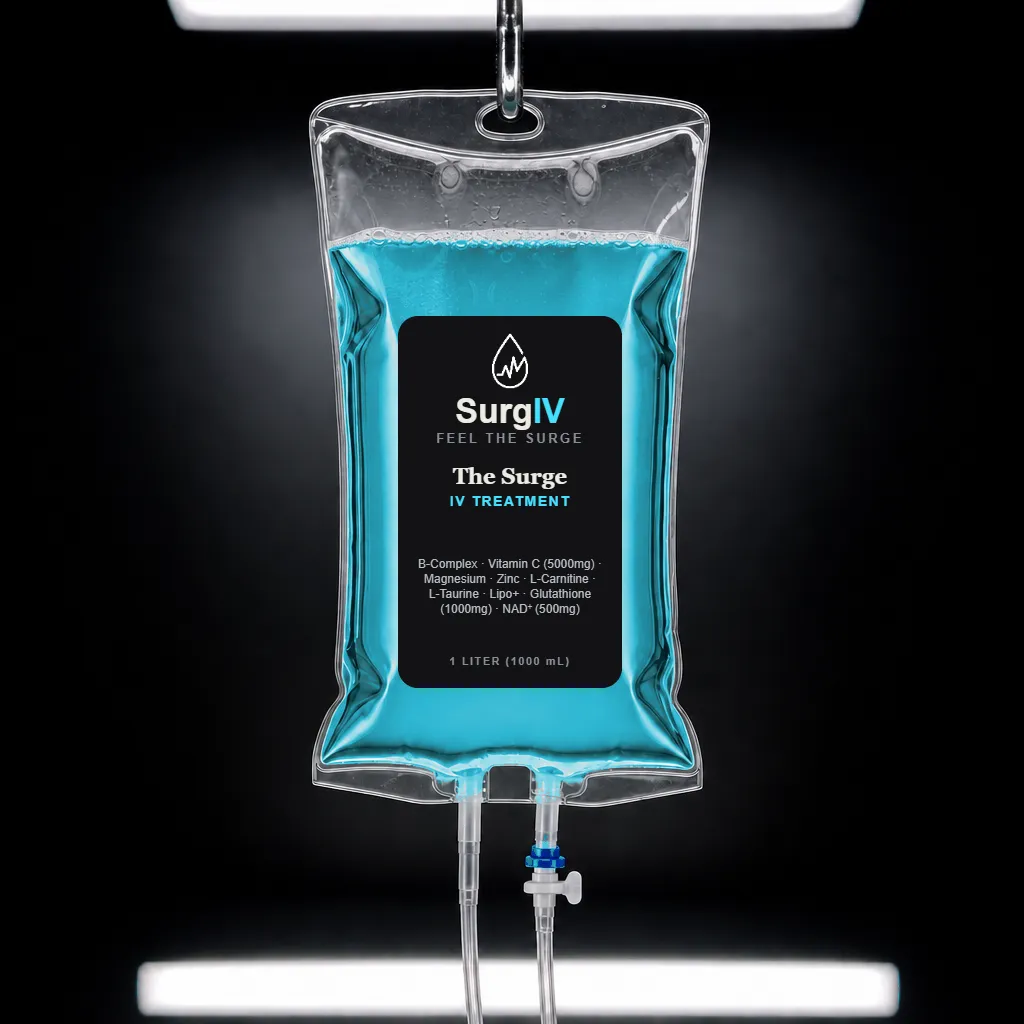
The training-budget refill
The Surge $899
500mg NAD⁺ with the full recovery formula — the athlete's configuration.
IV Bag: B-Complex · Vitamin C (5000mg) · Zinc · Magnesium · L-Carnitine · L-Taurine · Lipo+ + more
Marcus, season's end
The masters meet result, reported with swimmer's precision: two lifetime bests, both in the meet's back half — "the part where I usually fade." His revised answer to his own question, now offered to every skeptical lane-mate: "It doesn't make you faster. It makes you trainable at full volume at 44. Turns out that's where faster comes from." Mechanism, confirmed at the touchpad.
This article is for general education and is not medical advice. IV therapy at SurgIV is administered by registered nurses under physician-written protocols, with a health screening before your first visit. Talk to your doctor about what is right for you.