
7:30 PM, a bathroom counter in Jupiter, an audit in progress. A man we'll call Stefan — the shrine Stefan, whose optimism has since been redirected but not extinguished — is holding four bottles his wife has laid out like exhibits: a multivitamin, a "men's performance" blend, a greens powder, and a high-dose D3 someone recommended on a podcast. She reads the labels aloud. All four contain vitamin A. Three contain D. Stefan, doing the addition for the first time in two years of daily use: "Huh. That's... a lot of A. But it's fine — it's just vitamins." That sentence, Stefan, is the reason this article exists.
The two families
Vitamin safety splits cleanly along one line: water-soluble (the B family, C) — circulate in blood, surplus largely excreted, which is why your kidneys handle megadose C by making expensive urine; versus fat-soluble (A, D, E, K) — stored in fat and liver, accumulating over months. That storage is where genuine toxicity lives: vitamin A toxicity — liver damage, and serious birth-defect risk in pregnancy; vitamin D toxicity — dangerously high blood calcium, with kidney consequences. Both are real clinical entities, both essentially always from supplements rather than food, and both arrive exactly the way Stefan's counter is arranging them: stacked invisibly across multiple products nobody adds up.
Nobody overdoses on carrots. People overdose on four products that each seemed reasonable alone — the arithmetic happens on the bathroom counter, not at dinner.
The water-soluble asterisks
"You just pee it out" is mostly true and not entirely: B6 over long periods at high doses can cause peripheral nerve damage — a genuine, under-known risk that turns up in neurology clinics; high-dose niacin brings flushing and liver stress; megadose C brings GI upset and, in susceptible people, kidney-stone considerations. The B family's reputation for total harmlessness is 95% earned, and the missing 5% is worth knowing before anyone doubles a dose because more felt better.
Where the IV route sits
Straight answer: IV changes the math in both directions. It bypasses the gut's rationing — the entire point, and the reason blood levels reach places oral dosing can't — which is precisely why the safety story has to be protocol, not vibes: physician-designed formulas with defined doses, screening for kidney function and conditions, and a nurse asking what else you take (a question Stefan's counter demonstrates the necessity of). It's also why iron stays off the menu, why screening exists, and why "it's natural, it's totally safe" is the single most reliable marker of an operator who hasn't read a dosing table. Safety in this field is boring documents, not adjectives.
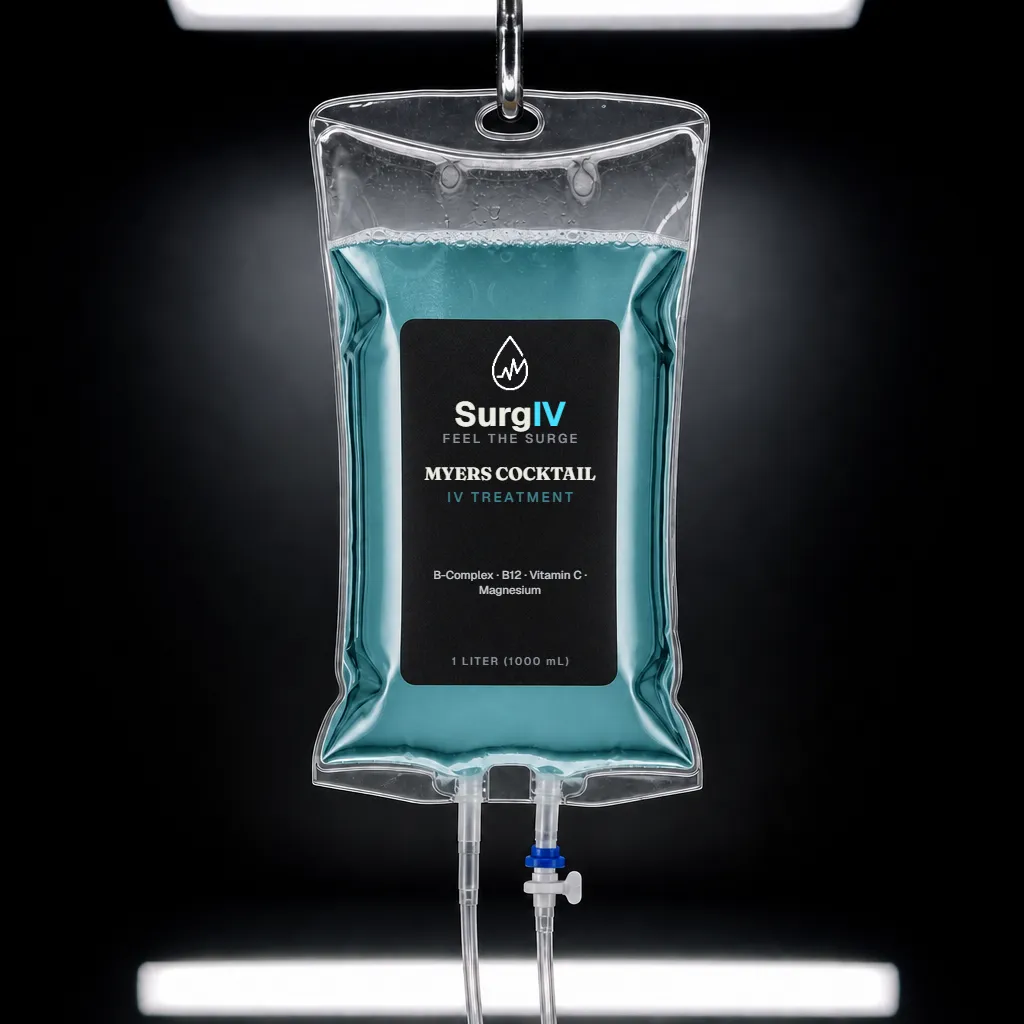
Dosed by protocol
Myers Cocktail $249
Physician-designed formulas, screened per client — the boring safety that matters.
B-Complex · B12 · Vitamin C · Magnesium
Stefan, counter rationalized
The audit ended with two bottles in the trash, a conversation with his physician about the D3 podcast dose, and a new house rule his wife enforces at intake: one list, all products, added up. His revised philosophy, delivered while dismantling exhibit three: "'It's just vitamins' means 'I haven't done the addition.' I hadn't. Two years of not doing addition." Do the addition. Tell your providers. Respect the four that stay.
This article is for general education and is not medical advice. IV therapy at SurgIV is administered by registered nurses under physician-written protocols, with a health screening before your first visit. Talk to your doctor about what is right for you.