
11:30 AM, a pharmacy aisle in Jupiter, cold-and-flu season's opening week. A man we'll call Gordon, 49, is loading his basket like a prepper: a 1,000mg vitamin C bottle, then — spotting it — a 2,000mg version. "Double," Gordon reasons, with the purity of a man who has never met a saturation curve, "is double." Somewhere in Gordon's small intestine, a fleet of transporter proteins reads this plan and files it under comedy. They have a ceiling to enforce, and Gordon's arithmetic isn't on the guest list.
Meet the transporters
Vitamin C doesn't drift into your bloodstream — it's escorted, by dedicated transporter proteins (SVCTs, for the label-readers) with finite seats per hour. Around 200mg a dose, absorption runs efficient; push toward 1,000mg and beyond, and the escorts saturate — absorption efficiency collapses to a fraction, and the surplus mostly transits unabsorbed, announcing itself at high doses as the GI upset every megadoser eventually meets. This is the ceiling: not a supplement-industry conspiracy but a design feature — your body rations water-soluble vitamins because it evolved for scarcity, not for Gordon's basket. The label's second thousand milligrams isn't a double dose. It's a donation to the drain.
The gut doesn't read labels. It counts seats on the escort fleet — and the fleet was full at milligram 400.
The workaround tier list
Liposomal C earns its partial credit honestly: the fat-bubble wrapper smuggles some cargo past the transporter queue, and studies show moderately higher blood levels than standard pills — the same B-minus the liposomal strategy earns elsewhere. But "moderately higher" still lives in the oral neighborhood. The IV is a different zip code: delivery straight to circulation produces plasma concentrations an order of magnitude beyond any swallowed dose — not because the vein is magic but because the rationing system is never consulted. That's the entire scientific basis of clinical high-dose C: some blood concentrations are simply unreachable by mouth, at any label size, in any wrapper.
Matching dose strategy to actual need
The honest sort: daily maintenance — food and modest supplements win; the ceiling exists because normal physiology needs a trickle, not a flood, and 200mg absorbed beats 2,000mg labeled. Episodic loading — immune-season pressure, recovery windows, deep depletion — is where IV-scale availability earns its booking: the Immune Boost's clinical dose delivered in one sitting, above the ceiling because it never approaches the door the ceiling guards. Trickle by mouth, load by vein. Gordon's basket had the right instinct and the wrong plumbing.
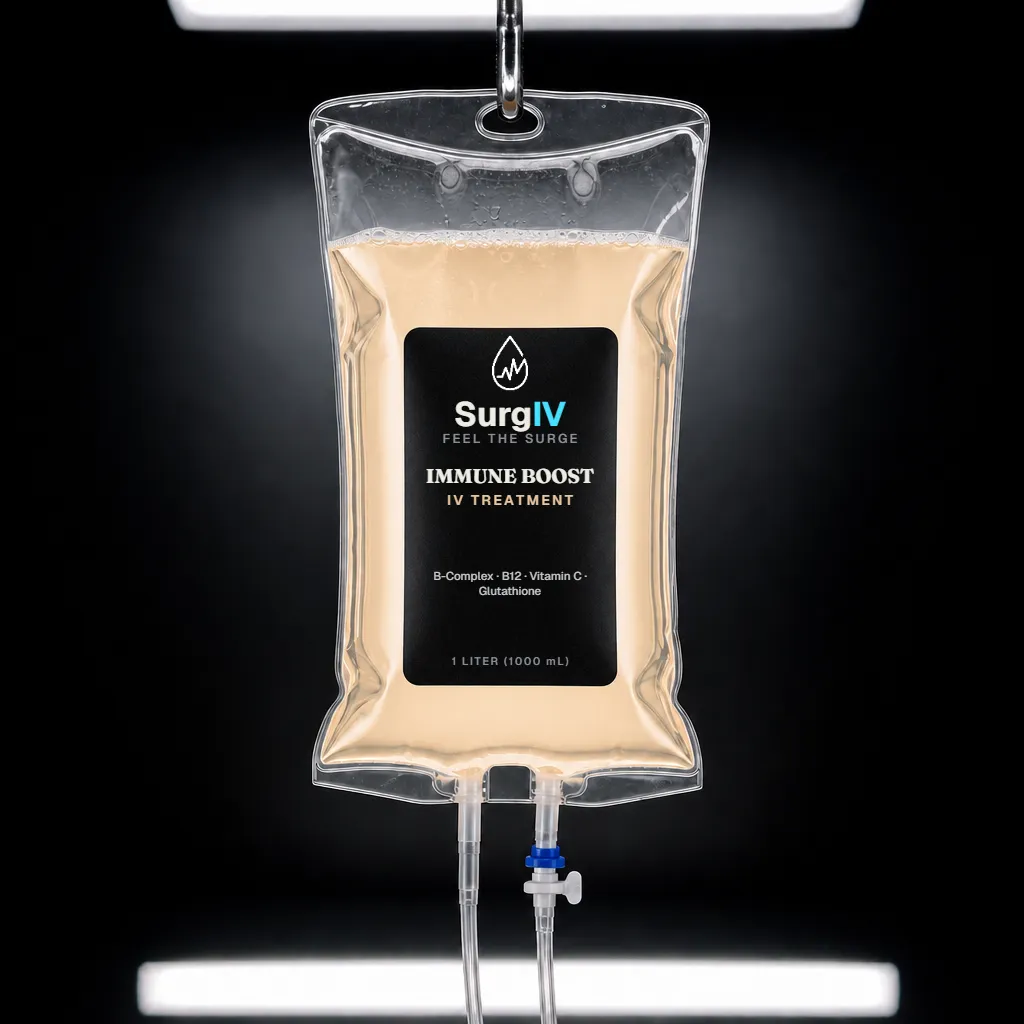
Above the ceiling
Immune Boost $299
Clinical-dose vitamin C, delivered where the transporters can't ration it.
B-Complex · B12 · Vitamin C · Glutathione
Gordon, post-curve
He kept the 1,000mg bottle ("fine, for Tuesdays"), returned the 2,000 ("apparently I was buying comedy"), and booked the family's immune-season drips for the week the school emails start. His new aisle heuristic, taught to a stranger reaching for the 3,000mg gummies: "Past the first few hundred, you're not raising your blood level. You're raising the label. Different products." The transporters, at last, respected.
This article is for general education and is not medical advice. IV therapy at SurgIV is administered by registered nurses under physician-written protocols, with a health screening before your first visit. Talk to your doctor about what is right for you.