9:50 PM, a bathroom in Palm Beach Gardens. A man we'll call Stefan, 52, has assembled on the counter what his wife has started calling "the shrine": a box of NAD⁺ patches from Instagram ($89/month), a nasal spray from a podcast ad ($65), and a browser tab open to our NAD⁺ IV page ($749). He applies a patch to his shoulder like a nicotine quitter, sprays the spray, and stares at the tab. "Same molecule," he mutters. "Why is one of these the price of a car payment?" Because, Stefan, the molecule was never the product. The delivery is.
The problem all four doors share
NAD⁺ is a big, fragile molecule your digestive tract simply destroys — swallowing it is the one route everyone agrees fails. That single fact created the entire market of alternate doors: vein, muscle, skin, nose. And the honest comparison between them comes down to one metric the packaging never prints: milligrams that actually reach circulation. The IV defines the ceiling — 250 to 1000mg, delivered by definition at 100%, which is why every dosage discussion is implicitly an IV discussion. Intramuscular injections are the legitimate runner-up: reliable absorption, smaller per-shot doses (typically 50–200mg), a real weekly-maintenance protocol some people rationally prefer. Then the gap opens.
The patch's problem in one sentence: NAD⁺ is a large charged molecule, and skin evolved specifically to keep large charged molecules out.
The skin and the nose, audited
Patches: transdermal delivery works beautifully for small lipophilic molecules — nicotine, some hormones. NAD⁺ is neither small nor lipophilic, marketed patch doses are modest even if fully absorbed, and published evidence of meaningful systemic delivery is close to nonexistent. Nasal sprays: tiny doses, minimal data, and a mucosal surface area that was never going to move loading-scale quantities. Neither product is dangerous; both are priced like conveniences and perform, on current evidence, like hopes. The cost math Stefan actually wanted: price the delivered milligram, not the package — the IV costs the most per session and the least per milligram that verifiably arrives; the shrine items are cheap per unit and, if delivery is negligible, infinitely expensive per unit delivered.
The honest protocol menu
Where that leaves a rational buyer: IV loading for the real intervention — full doses, the flush and all, the route the research doses assume; IM maintenance as the defensible economy option between sessions; oral precursors (NR, NMN — a different strategy entirely, and a legitimate one) for daily-pill temperaments; and the patch-and-spray shelf reserved for people who enjoy subscriptions. The molecule is identical everywhere it's sold. The doors are not.
The full-dose route
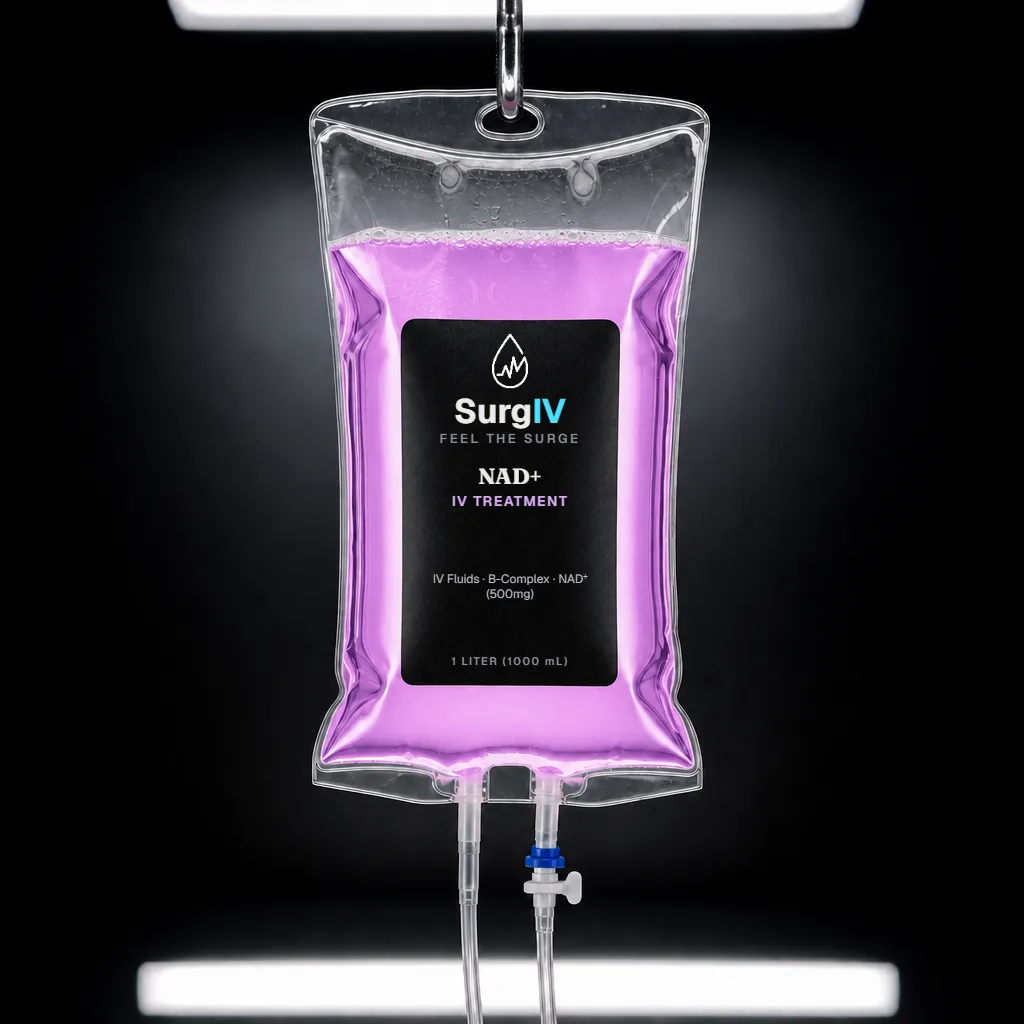
NAD+ $749
500mg, intravenous, complete delivery — the route the others approximate.
IV Fluids · B-Complex · + 3 IM Shots: B12 · D3 · CoQ10
Stefan, shrine audited
He ran the math himself — engineer's spreadsheet, cost per plausibly-delivered milligram — and the shrine lost by an order of magnitude. New protocol: quarterly IV loading, precursor pills daily, patches relegated to — his words — "the drawer of optimism, with the posture corrector." Same molecule, four doors, one of them load-bearing. Price the door.
This article is for general education and is not medical advice. IV therapy at SurgIV is administered by registered nurses under physician-written protocols, with a health screening before your first visit. Talk to your doctor about what is right for you.