
Sunday, 9:15 AM, a field in Lake Worth. The county's men's league Division 3 is underway, featuring twenty-two adults in various stages of negotiation with their former athletic selves. Among them: a midfielder we'll call Dmitri, 39, who played semi-pro in his twenties and retains — this is the problem — the top speed memories without the supporting infrastructure. In minute 63, a through-ball opens, the memories fire, Dmitri hits what his brain files as a routine sprint... and his right hamstring sends what can only be described as a formal notice: a warning twinge, the universal adult-league semaphore for "we need to talk about your expectations."
Dmitri jogged it off — this time. This guide is for him, and for every weekend footballer in the county's thriving league scene: what the sport actually charges, and the maintenance that keeps you rostered past minute 63.
The sprint tax (why the gym doesn't cover it)
Soccer's demand profile is unique among the county's weekend sports: not steady output but repeated maximal efforts — dozens of sprints, hard decelerations and direction changes across 5–7 logged miles, every one an eccentric-loading event your treadmill Zone 2 never rehearsed. This is why gym-fit players still get destroyed by league play: the engine transfers, but the sprint-specific machinery (and above all the hamstrings — the muscle absorbing peak loads at acceleration and full speed) runs on training it isn't getting. Add the Florida match environment — 90 minutes in dew-point air, 2–3 liters of sweat, the humidity performance tax applied to every sprint — and the fatigue curve steepens exactly into the danger zone: most adult-league hamstring pulls happen after minute 60, because the tired hamstring is the vulnerable one. Dmitri's minute-63 telegram was right on schedule.
Adult league soccer: where the top speed is remembered and the supporting infrastructure is not.
Staying rostered (the midweek half of the sport)
The players who last full seasons treat the week as part of the game: the real warm-up — progressive sprint build-ups before kickoff (two chatting laps is a social custom, not a warm-up; the hamstring wants rehearsal); the Nordic prescription — hamstring-specific strength work midweek, with Nordic curls carrying the sport's best injury-prevention evidence; the substitution honesty — coming off when genuinely gassed, because the fatigue-injury statistic is the most reliable in football and Division 3 glory heals slower at 39; and the match-day settlement — immediate electrolyte rehydration (the match's multi-liter invoice), protein in the window, Monday movement over Monday couch, and — for the players stacking league onto full lives — the Recovery IV Sunday evening: fluids for the sprint-sweat math, aminos for the eccentric-loading rebuild, the Monday tax pre-paid. Several county teams now run it as a post-match option at the captain's place — the group format with match highlights and disputed offside calls included.
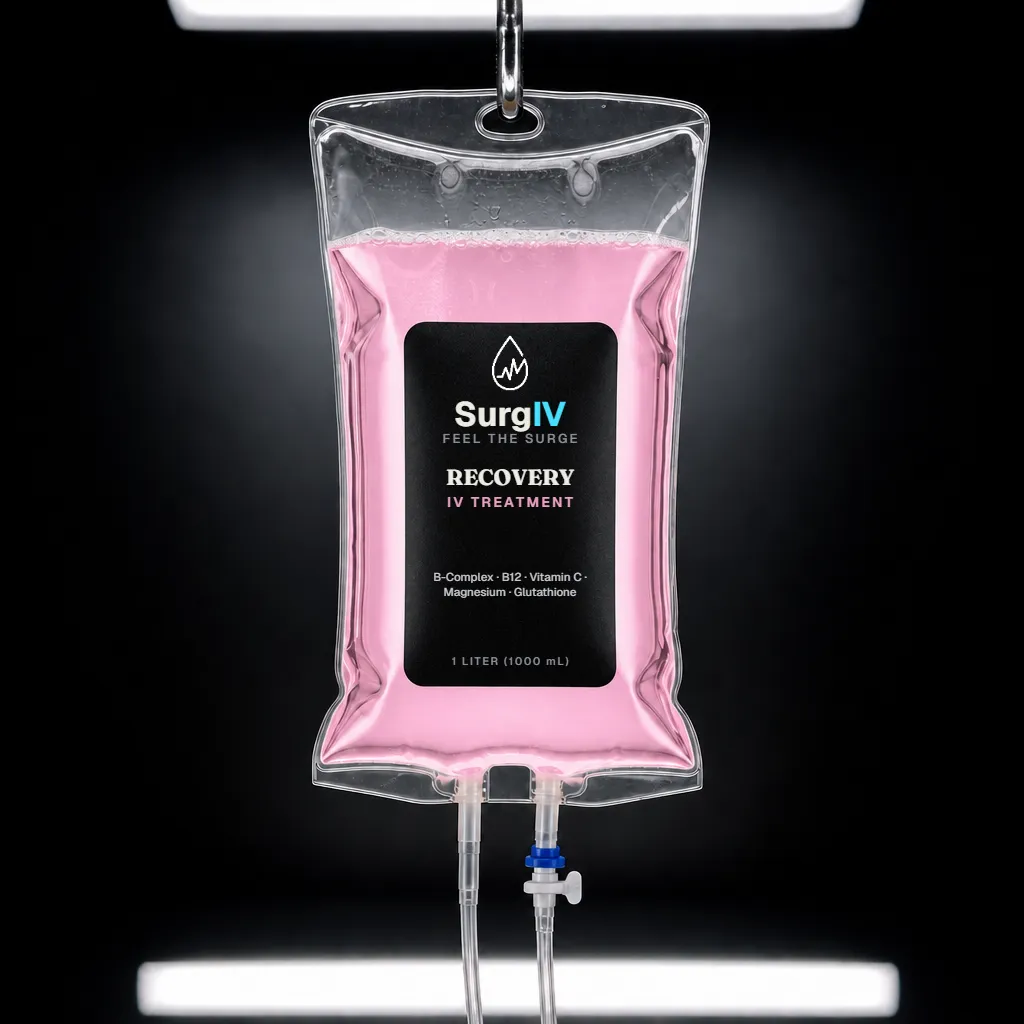
The Monday-proof protocol
Recovery $299
Fluids, aminos and minerals after the match — hamstrings' resignation letters, declined.
B-Complex · B12 · Vitamin C · Magnesium · Glutathione
Dmitri, end of season
The post-twinge protocol — Nordics on Wednesdays, real warm-ups, the Sunday-evening session after doubleheaders — carried Dmitri through the full spring season un-pulled, a Division 3 first for him. His assessment, delivered with midfielder's economy: "The legs remember being 24. The recovery plan is how I stop them from writing checks." The league runs year-round, county. Keep the infrastructure funded — the memories are already paid for.
This article is for general education and is not medical advice. IV therapy at SurgIV is administered by registered nurses under physician-written protocols, with a health screening before your first visit. Talk to your doctor about what is right for you.