
Every summer, Palm Beach County hosts the same scientific demonstration: a visitor from Phoenix — a person who golfs at 108° without complaint — steps out of PBI's terminal into a 91° afternoon and stops walking. Physically stops. A client of ours witnessed her Arizona brother-in-law's version of this moment and recorded his review for posterity: "It's like the air is... pre-owned. Someone already breathed all of this."
He's describing, with perfect accuracy, a number he's never checked: the dew point. It's the single most useful weather statistic for living in this state, almost nobody knows theirs, and five minutes of understanding it will change how you schedule, exercise, hydrate and survive here. Class is in session.
Your cooling system has one trick
The human body's serious cooling mechanism is evaporation: sweat converts to vapor off your skin, and that phase change carries heat away. Note the requirement — the sweat must evaporate. Sitting on your skin, it's just wetness; the cooling happens only at the moment of vaporization, and vaporization requires air with room for more moisture. Which brings us to the number: dew point measures how much moisture the air already holds. Below 60°F: dry-feeling air, sweat vanishes, cooling excellent. 65–70: sticky, cooling degraded. Above 70 — Florida's summer home — the air is functionally full: your sweat pours and sits, the cooling barely happens, and your body responds the only way it can: by sweating even more. Maximum fluid loss, minimum cooling. The Arizona brother-in-law's 108° with a 40° dew point cools him better than our 91° at 76 — his sweat works; ours just leaves.
"The air is pre-owned. Someone already breathed all of this." — the most accurate description of a 76° dew point ever recorded
What this changes in practice
- Check the dew point, not the temperature. Every weather app shows it. Below 65: normal rules. 65–72: hydrate deliberately, pace outdoor effort. Above 72: the athlete's conversion math applies to everyone — slow down, schedule around the 11-to-3 furnace, and treat exertion as a fluid event.
- Respect the heat index — it's the honest number. The "feels like" figure is temperature adjusted for your disabled cooling; heat illness tracks it, not the thermometer. Index above ~103: outdoor exertion enters the territory where Tom's story happens.
- Understand the invisible tax. The pouring-without-cooling cycle is why Florida runs the standing deficit this blog maps relentlessly: you lose more here at 91° than the visitor loses at 108°, daily, often without a single visible drop — the wind and AC evaporate the evidence, never the loss.
- Acclimate, then respect it anyway. Two weeks of gradual exposure genuinely upgrades your cooling (more efficient sweat, expanded plasma volume — the snowbirds' October project). But adaptation discounts the bill; it never cancels it.
The resident's contract
Living here is a deal: the winters everyone else dreams about, in exchange for summers spent inside an atmosphere working against your physiology. The residents who thrive read the fine print — dew point checked like a surf report, fluids run on schedule rather than thirst, the furnace hours ceded to the AC, and the deep-deficit reset on call for the days the contract collects anyway (the boat Saturdays, the tournaments, the yard work that got ambitious). The Arizona brother-in-law, for the record, spent his visit indoors by 11 AM daily and left with new respect: "Our heat is a pizza oven. Yours is a slow cooker. I'll take the oven." He can have it. We have the winters — and the number, now that you know to check it.
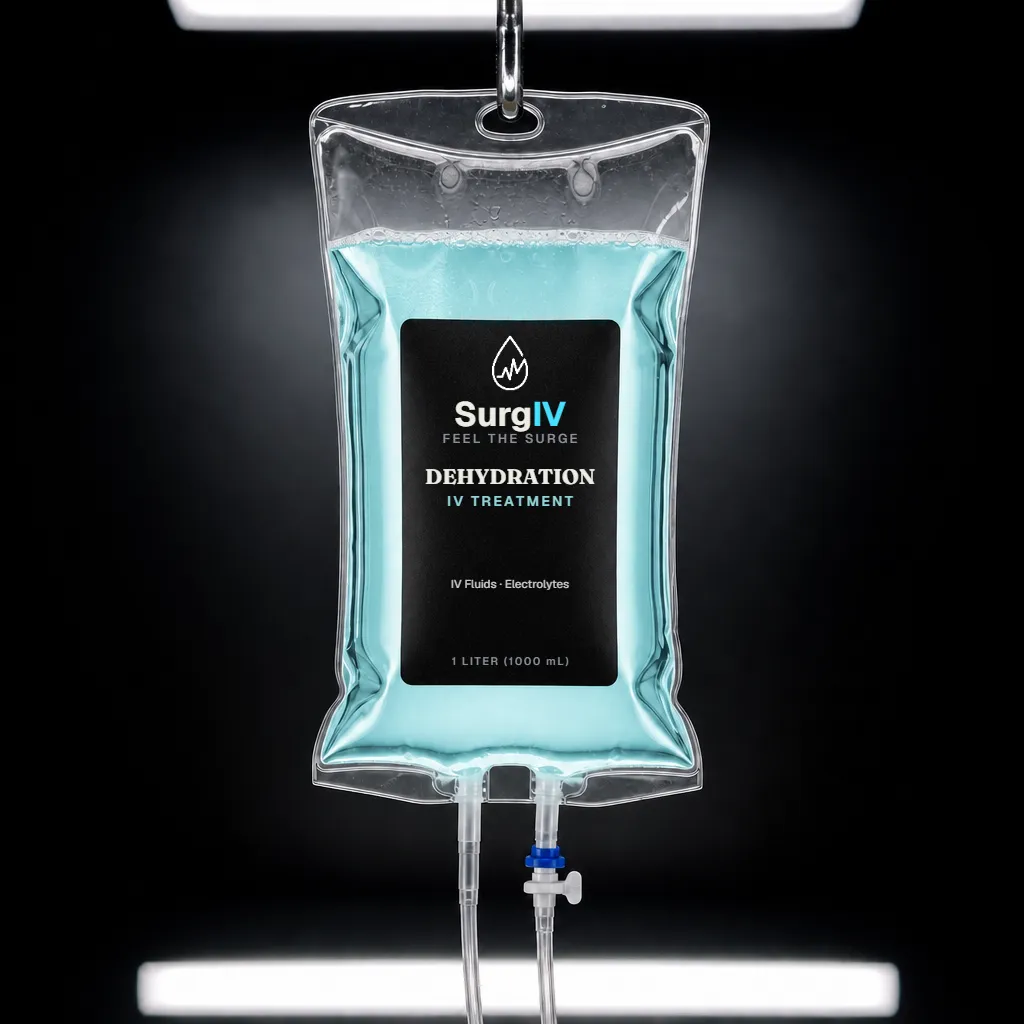
Built for this climate
Dehydration $199
The rehydration service a dew-point state actually requires.
IV Fluids · Electrolytes
This article is for general education and is not medical advice. IV therapy at SurgIV is administered by registered nurses under physician-written protocols, with a health screening before your first visit. Talk to your doctor about what is right for you.