
3:25 PM, a supplement aisle in Palm Beach Gardens, two bottles and one very stuck shopper. A woman we'll call Deb, 56, holds NMN in her left hand ($72) and NR in her right ($58), while her phone displays a third option a friend texted her: our NAD⁺ IV page. Her browser history from the past hour: "nmn vs nr which better", "is nad the same as nmn", "why is one letter different $14." Deb has wandered into biochemistry's worst-named aisle, and she's not leaving without a diagram.
The diagram
Here it is, the whole trio in one line: NR → NMN → NAD⁺. It's a supply chain. NAD⁺ is the finished product — the coenzyme your cellular machinery actually spends, thousands of times a day, the one whose decline tracks the decades. NR (nicotinamide riboside) and NMN (nicotinamide mononucleotide) are its precursors — raw materials one and two steps upstream, small enough to survive digestion, which finished NAD⁺ famously is not. That's the entire reason precursors exist as products: you can't swallow the finished good, so the pill aisle sells the ingredients. Your cells run the final assembly. Deb's $14 mystery is one enzymatic step's worth of branding.
NAD⁺ is the cash. NMN and NR are checks that clear into it — if the bank's open. IV delivery is handing over cash directly.
The evidence, scored fairly
NR holds the stronger human portfolio: multiple trials showing it reliably raises blood NAD⁺ levels, plus the cleaner regulatory history — it's the better-papered check. NMN is one step closer to the finished molecule and its research is promising, but U.S. regulatory reshuffling complicated its market, and head-to-head superiority over NR remains unproven. The honest ceiling for both: they demonstrably raise NAD⁺ levels; the hard clinical outcomes — lifespan, disease endpoints — are still being earned, and anyone selling certainty is selling ahead of the data. Direct NAD⁺, meanwhile, skips the supply chain: IV delivery is the one route that hands cells the finished coenzyme at loading scale — the route comparison covers why the vein beats every other door.
The strategy menu, assembled
The rational combinations, in plain terms: daily oral NR as the steady baseline (the best-evidenced pill play); periodic NAD⁺ IV loading for the direct top-up precursors approximate; or the hybrid our menu was built for — Niagen+ delivers NR itself intravenously, precursor strategy at complete delivery, while the NAD⁺ drip hands over the finished molecule. Pills for maintenance, drips for loading. The aisle's three names were never rivals — they're one supply chain sold at three different depots.
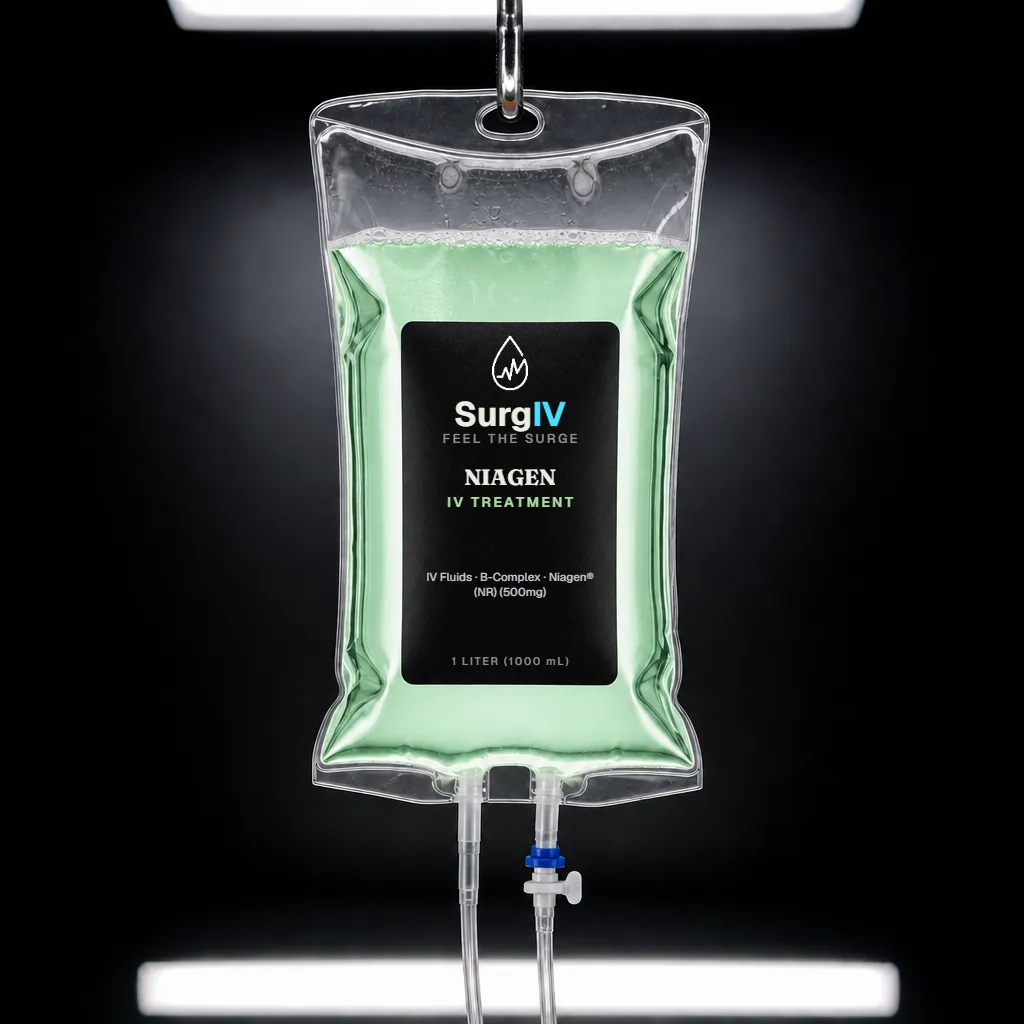
Precursor, delivered properly
Niagen $749
Pharmaceutical-grade NR, intravenous — the precursor strategy at full strength.
IV Fluids · B-Complex · Niagen® (NR) (500mg)
Deb, diagrammed
She bought the NR ("better paperwork"), booked a quarterly NAD⁺ drip after the friend's testimony held up, and — being Deb — taped an index card inside her supplement cabinet for future generations: "NR becomes NMN becomes NAD. Pills = ingredients. IV = the finished thing. Stop googling this at the store." The aisle's worst-named trio, solved with one arrow and two bookings.
This article is for general education and is not medical advice. IV therapy at SurgIV is administered by registered nurses under physician-written protocols, with a health screening before your first visit. Talk to your doctor about what is right for you.