
Of all the questions clients ask mid-drip, the one that most delights our nurses came from a retired chemistry teacher in Delray — we'll call her Miss Patterson, 74, monthly Myers', reads every label on principle — squinting at her bag: "Young lady, this says Lactated Ringer's. My neighbor's bag last week said saline. Are we drinking from different wells? And who, precisely, was Ringer?"
Miss Patterson had discovered medicine's quietest foundational choice — the base-fluid decision underneath every formula that almost no menu mentions. The story is better than it has any right to be. (And Ringer was Sydney Ringer, a Victorian physician whose lab assistant famously used London tap water instead of distilled — accidentally revealing that the minerals in the water were keeping the experiment's frog hearts beating. Science owes a debt to that shortcut.)
The two wells
Normal saline is elegant simplicity: water and 0.9% sodium chloride — salt at blood's exact concentration, so it flows into veins without cellular drama. It's the universal workhorse: compatible with nearly everything, predictable, a century of service. Lactated Ringer's is the fuller imitation: sodium and chloride plus potassium, calcium, and a lactate buffer — a closer copy of blood plasma's whole electrolyte profile (the grid, pre-installed), descended from Ringer's frog-heart minerals and refined into modern form in the 1930s. The design philosophies in one line: saline replaces volume; Ringer's replaces plasma.
"Who, precisely, was Ringer?" — a Victorian physician, a lazy lab assistant, some London tap water, and the accidental birth of balanced fluids.
Does it matter? (The honest sizing)
For a healthy adult receiving a wellness liter: both work well, and anyone dramatizing the difference is selling. The real distinctions, honestly sized: LR's fuller mineral profile makes it the natural rehydration-forward choice — a depleted system gets the potassium and calcium along with the volume; the buffer story — at large volumes (multi-liter hospital resuscitation), saline's pure chloride load can nudge acid-base balance, which is why big-volume medicine has trended toward balanced fluids like LR (interesting context; not a practical concern at one liter); and compatibility — saline's simplicity makes it the safer partner for certain additives, a real constraint from the formula-design gauntlet (LR's calcium, for instance, disagrees with some compounds). Which is why the professional answer to 'which is better' is the unsatisfying true one: per formula, per job, per protocol — our rehydration-forward and flagship formulas (the Surge's card lists Lactated Ringer's first) ride the balanced base; saline serves where the chemistry votes for it.
The label-reader's takeaway
What Miss Patterson's discovery adds to the menu-literacy toolkit: the base fluid is one more legibility test — a provider who can tell you which base and why has protocols behind the menu; one who's never considered the question is hanging whatever the distributor shipped. It's a small tell with large implications, exactly the kind this blog collects. Different wells, both good, chosen on purpose: that's the whole standard.
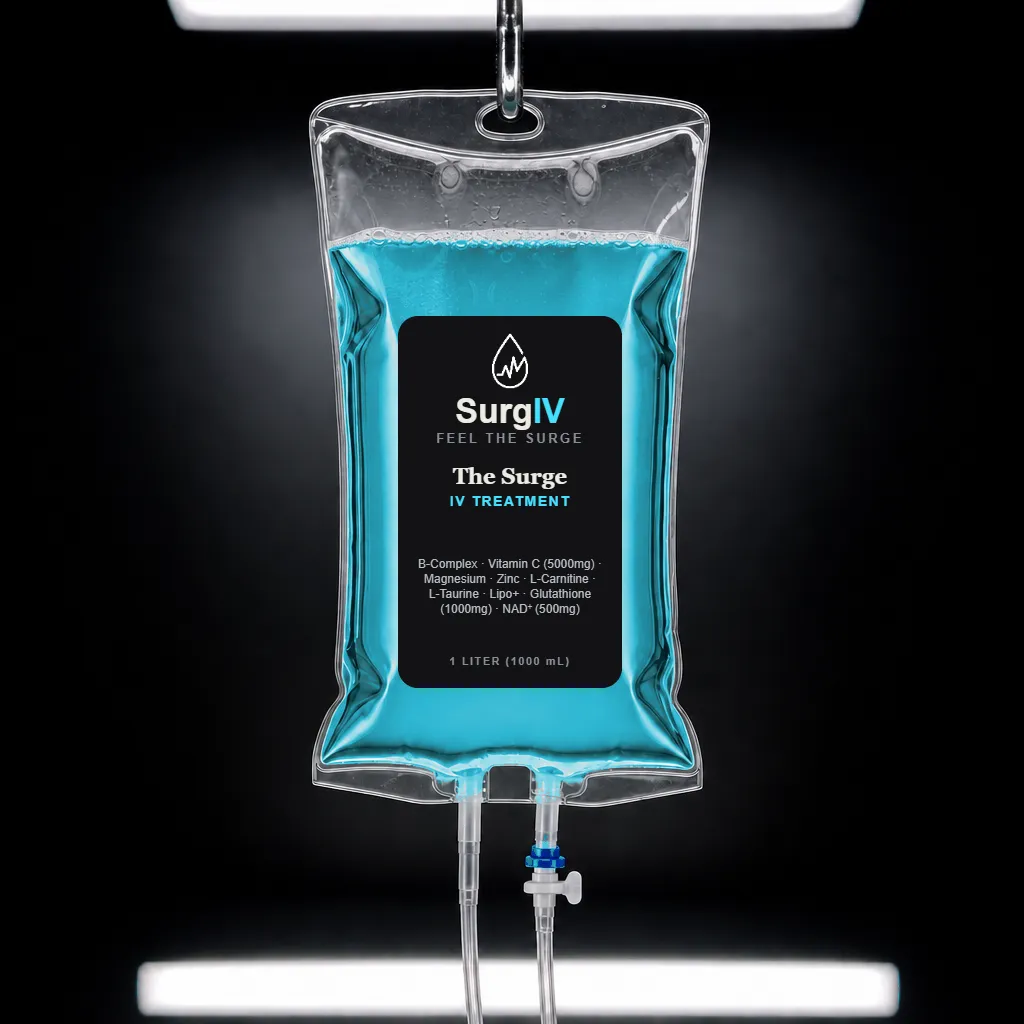
Built on Ringer's
The Surge $899
The Surge runs on Lactated Ringer's — the fuller-spectrum base for the flagship formula.
IV Bag: B-Complex · Vitamin C (5000mg) · Zinc · Magnesium · L-Carnitine · L-Taurine · Lipo+ + more
Miss Patterson, satisfied
Her verdict, delivered with a chemistry teacher's authority: "Balanced fluids, deliberate selection, and a proper answer with a historical anecdote. You may keep my Tuesdays." The highest grade we've received. Sydney Ringer's lab assistant, wherever he is, shares the credit.
This article is for general education and is not medical advice. IV therapy at SurgIV is administered by registered nurses under physician-written protocols, with a health screening before your first visit. Talk to your doctor about what is right for you.