
The Surge contains 500mg of NAD⁺. Not 250. Not 1000. Five hundred — and there was an argument about it. An actual argument, in a protocol review, between our medical director and the clinical literature and the session-length math and the honest question of what members would reliably rebook. The 500 won on the merits. That argument is the product. Most of this industry would rather you not think about whether their menu ever had one.
So here's the process opened up: how a formula actually gets designed at a legitimate operation — the people, the constraints, the trade-offs — so you can hold any drip menu in the county up to the light and see whether anyone argued over it.
Step one: the job description
Every formula starts as a use case, not an ingredient list. The Hangover IV's brief: counter four specific injuries (fluid loss, B-burn, gut revolt, inflammation) in under an hour on a nauseous client. The Surge's brief: the most complete single wellness session buildable within safety constraints. Design runs backward from the job — which is why formulas differ at all, and why the menus that read like the same six vitamins reshuffled fourteen times were built forward from a price list instead.
Step two: the physician and the literature
The medical director owns the protocol — a written document (its existence is itself the credential) defining each ingredient's dose, the infusion rate, the contraindications, and the screening questions it obligates. Doses come from clinical literature and established parenteral practice, not from marketing round numbers: magnesium at levels that help without flushing, vitamin C at grams because that's where the IV route's advantage lives, NAD⁺ at 500 for the reasons that won the argument. Every milligram has a citation or it doesn't ship.
A protocol is a formula's birth certificate. Ask to see one — the reaction tells you everything.
Step three: the constraint gauntlet (where amateur menus die)
Then chemistry gets a veto. Compatibility: some compounds degrade or precipitate when mixed — the reason certain trendy combinations don't exist isn't imagination, it's chemistry (and the reason glutathione often runs as its own push at the end). Osmolarity: the solution's total concentration must stay vein-friendly; you can't just keep adding — every addition dilutes room for others. Formula design is substantially the art of what you can't combine. Rate rules: NAD⁺ demands slowness, magnesium has ceilings — the bag's contents dictate the session's clock. Stability: mixed vitamins degrade on timelines measured in hours, which is why per-visit compounding is a quality marker and pre-mixed bags-in-a-fridge are a red flag. Screening load: every ingredient added is a contraindication list inherited — the protocol's screening questions grow with the formula.
Step four: the feedback loop
Ship, then listen. Nurse reports (who's flushing at what rates), member outcomes (does the recovery formula actually shorten the reported recovery), new literature — all of it feeds protocol review, where doses get defended again or revised. Our own Peak Performance exists because the Surge's process revealed a distinct athlete use-case that deserved its own brief. A menu that never changes isn't timeless; it's unattended.
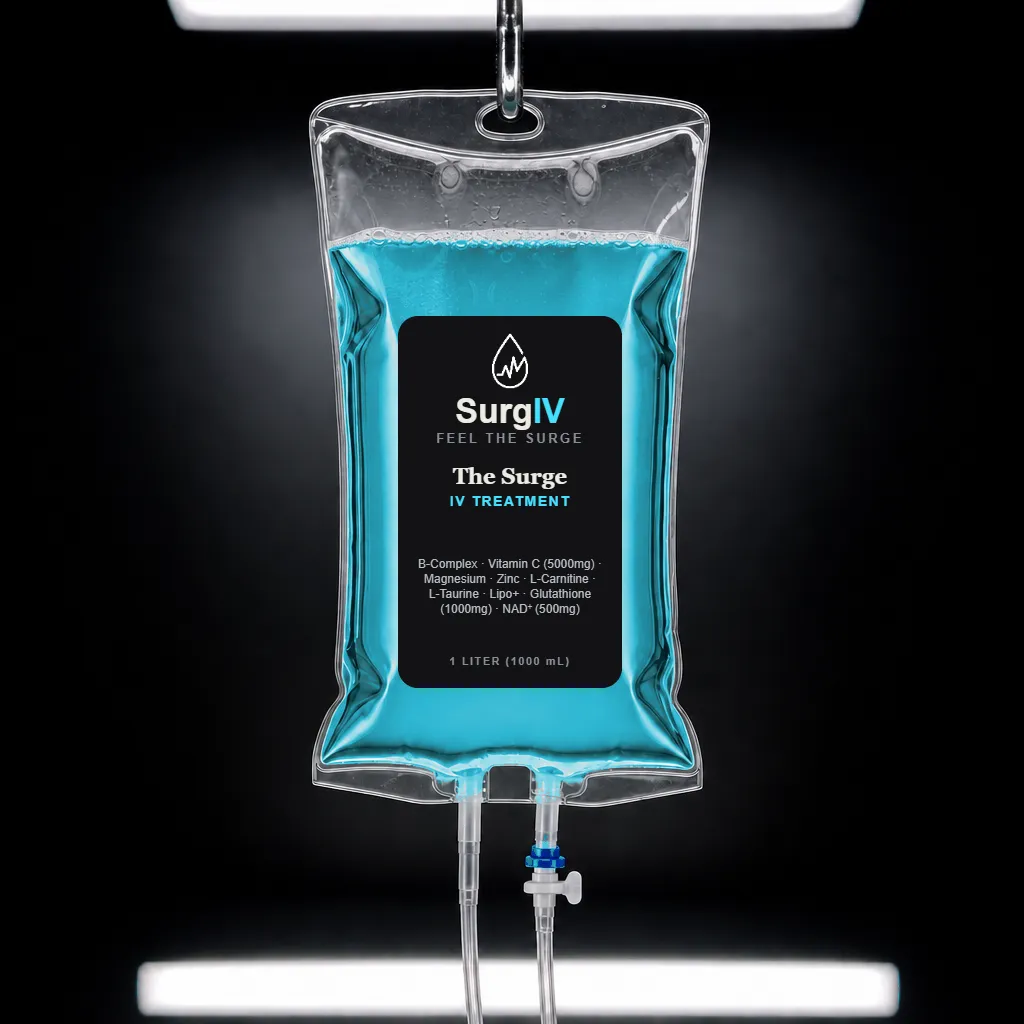
Design, not decoration
The Surge $899
Every ingredient argued for, every dose defended — the flagship is the process's proof.
IV Bag: B-Complex · Vitamin C (5000mg) · Zinc · Magnesium · L-Carnitine · L-Taurine · Lipo+ + more
The question that sorts the county
All of this compresses into one question you can ask any provider: "Who designed this formula, and can I see the doses?" The legitimate answer names a physician and produces milligrams. The other answer is a pause, a pivot, or a "proprietary blend" — which translates, roughly, to nobody argued over this bag. Ours were argued over. It's the best thing we can tell you about them.
This article is for general education and is not medical advice. IV therapy at SurgIV is administered by registered nurses under physician-written protocols, with a health screening before your first visit. Talk to your doctor about what is right for you.