
Ask anyone what zinc does and you'll get the lozenge answer — that chalky winter memory, the cold-aisle purchase, the vague sense that it "helps with colds, maybe." A client we'll call Ray, 47, gave our nurse exactly that answer during his intake — right before mentioning, in an unrelated tone, that cuts had been taking forever to heal lately, food tasted "flatter than it used to," and he'd had three lingering colds since fall. The nurse's response: "Ray, you just listed zinc's résumé as complaints."
The 300-job mineral
Zinc is a cofactor in roughly 300 enzymes — a portfolio rivaling magnesium's — and its jobs read like Ray's symptom list run backwards: immune machinery (zinc is required for developing and deploying immune cells; the response surge spends it — the mechanism behind the lozenge folklore, which has a real kernel); wound healing (tissue repair enzymes run on it — the forever-cut is a classic tell); taste and smell (the receptor systems are zinc-dependent; 'food tastes flat' is textbook); skin integrity (its dermatology résumé spans healing and inflammation); and hormone support (testosterone synthesis requires it — part of why the deficiency pattern in men includes flagging energy). One mineral, three hundred assignments, zero of which you consciously assigned.
"You just listed zinc's résumé as complaints" — the intake conversation that happens weekly, once you know the résumé.
Who runs low (Florida edition)
The risk roster has a distinctly local flavor: heavy sweaters — zinc exits in sweat, making the county's athletes, outdoor workers and boat people chronic spenders; regular drinkers — alcohol impairs absorption and increases excretion (another line on the drinking ledger); plant-based eaters — plant zinc absorbs poorly and phytates block it (a solvable planning problem, but a real one); older adults (absorption declines); and the gut-compromised. Ray — a golfing, social-drinking 47-year-old — was three-for-five on the roster without knowing a roster existed. The confirmation path, as always: a doctor's lab beats guessing, and true deficiency deserves medical management.
The dosing wisdom (and the copper trap)
Zinc carries a caution its cold-aisle reputation obscures: chronic high-dose oral zinc induces copper deficiency — the minerals compete for the same absorption machinery, and the megadosing enthusiast pattern (a lozenge habit that never ended) can trade one deficiency for a worse one. The sensible structure: dietary coverage first (oysters famously, meat, seeds), modest supplementation for roster members, and working doses at the right moments — which is precisely the Immune Boost's design: zinc paired with gram-level vitamin C, delivered at full availability when the account matters most — germ season, the rebuild window, the run-down stretch. Supply-side support at the moments of demand, not megadosed monotony.
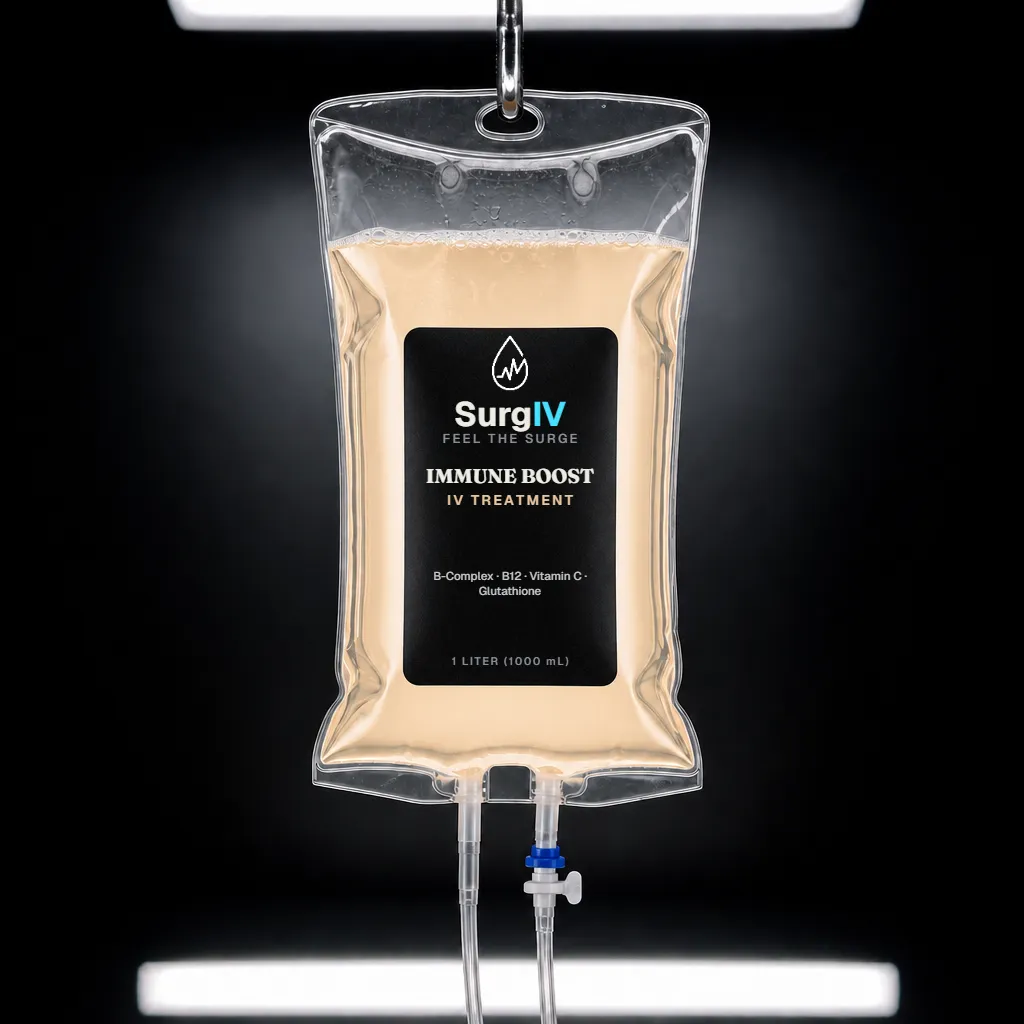
Zinc at working dose
Immune Boost $299
Paired with high-dose C in the immune formula — the mineral's best-known job, fully funded.
B-Complex · B12 · Vitamin C · Glutathione
Ray, re-zinced
Ray's follow-up, three months post-lab (confirmed low-normal, doctor looped in) and two Immune Boosts later: cuts healing on schedule, food "tasting like food," cold season navigated with one minor skirmish. His revised answer to the what-does-zinc-do question, now delivered at dinner parties with convert's precision: "Everything, quietly, until it can't. Then you find out what the lozenge aisle never told you."
This article is for general education and is not medical advice. IV therapy at SurgIV is administered by registered nurses under physician-written protocols, with a health screening before your first visit. Talk to your doctor about what is right for you.