Every ingredient in the famous yellow bag has a reason, but one earns the headline slot in every hospital protocol — listed first, given first, non-negotiable: thiamine. Vitamin B1. A nutrient most people couldn't pick out of the alphabet soup, holding priority position in emergency medicine's most-hung bag. A client we'll call Marcus — a nurse himself, booking a post-block session — put the question to our nurse colleague-to-colleague: "You know what I've always wondered? WHY thiamine first? We just... do it. Protocol says B1 before glucose, every time. Nobody ever explains it at the bedside."
Here's the bedside explanation — a story that runs from Saturday-night chemistry to serious medicine, worth knowing at every point on that spectrum.
The foreman and his smallest warehouse
Thiamine's job, from the family tour: the carb-conversion foreman — the required cofactor for turning carbohydrates into cellular energy, with the brain (a nearly pure carb-burning organ) as its single biggest client. Its vulnerability: B1 runs the family's smallest warehouse — body reserves last weeks, not months, making it the first B to run dry under any sustained drain. And alcohol is its perfect adversary, attacking on three fronts at once: impairing gut absorption, blocking conversion to the active form, and accelerating excretion — while heavy drinking's dietary patterns displace the foods that would restock it. Every drink taxes the account; sustained heavy drinking sieges it.
"Protocol says B1 before glucose, every time. Nobody ever explains it at the bedside." — the question this article answers
Why B1 goes first (the serious end of the spectrum)
The protocol's logic lives at depletion's far end: Wernicke's encephalopathy — the neurological emergency of severe thiamine deficiency (confusion, eye-movement abnormalities, unsteady gait), classically seen in sustained heavy drinking with poor nutrition. The bedside answer Marcus wanted: glucose metabolism consumes thiamine — so giving IV glucose to a B1-depleted patient can push them over the edge, which is why every protocol on earth runs thiamine before the sugar. It's one of medicine's cleanest examples of sequence-as-safety, and the entire reason the yellow bag's headline ingredient is a vitamin most people have never consciously consumed. The boundary, drawn plainly: that territory is hospital medicine — and if the drinking volumes in this section feel personal rather than academic, the right conversation is with a doctor, early, and it's a conversation that saves lives.
The everyday end (where most readers live)
Social drinkers aren't in Wernicke territory — but the same triple-drain runs at proportional scale, which is the honest mechanism behind the morning-after's energy crater and the reason B-complex belongs in every legitimate recovery formula: the Hangover IV's B-restock (thiamine included) is the civilian application of the hospital's logic — replace what the metabolism spent, at full delivery, alongside the fluids. The regular-drinker's layer: a cheap oral B-complex as standing insurance (the family drains together — NAD⁺'s ledger runs parallel), the recovery formula after big weekends, and the prevention playbook protecting every account upstream.
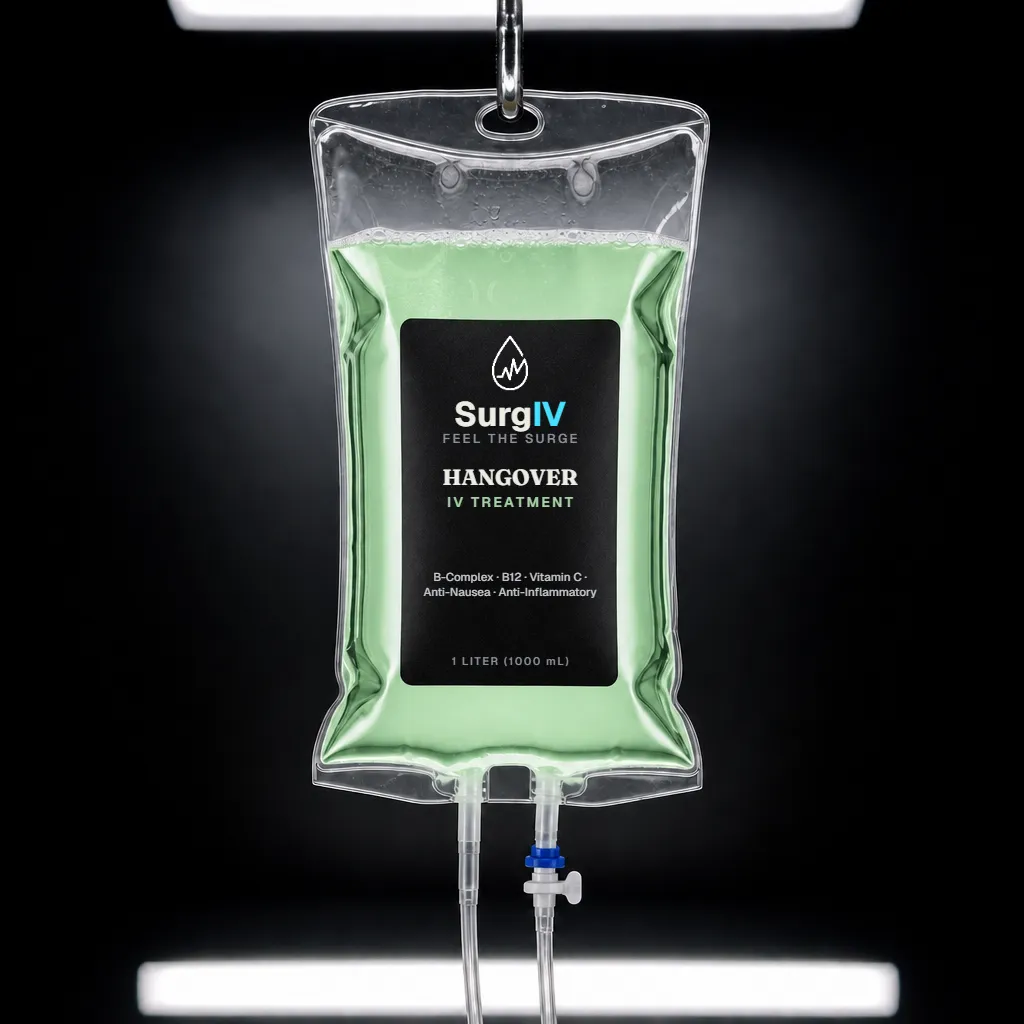
The B1 restock
Hangover $249
B-complex with thiamine in the recovery formulas — the account drinking drains first.
B-Complex · B12 · Vitamin C · Anti-Nausea · Anti-Inflammatory
Marcus, protocol explained
His response, colleague-to-colleague: "Fifteen years of hanging banana bags and I finally know why B1 rides shotgun. I'm telling every new grad on my unit — and stealing the 'smallest warehouse' line for it." Granted freely, Marcus. Some protocols deserve their bedside story told — especially the ones written in yellow.
This article is for general education and is not medical advice. IV therapy at SurgIV is administered by registered nurses under physician-written protocols, with a health screening before your first visit. Talk to your doctor about what is right for you.