
8:05 AM, Saturday, a gym parking lot in Palm Beach Gardens. Three men from the same 6 AM class stand by their cars comparing damage from Thursday's leg day, and the conversation is accidentally a longitudinal study. The 28-year-old: "Sore Friday morning, fine by Friday night." The 41-year-old: "Fine this morning. Mostly." The 55-year-old, easing into his driver's seat with visible diplomacy: "Gentlemen, I will see Thursday's workout again on Monday. We have an arrangement." Same workout. Three invoices. Nobody did anything wrong — they're just standing at three points on the one chart every athlete eventually reads.
The chart, honestly drawn
For the same hard session, the honest ranges: 20s — 24 to 48 hours, the decade of seemingly free recovery; 30s — 48 becoming standard, the first "huh" decade; 40s — 48 to 72, where the not-recovering conversation begins; 50s and beyond — 72-plus, with the hardest sessions billing most of a week. Two caveats keep the chart honest: individual variation is enormous — a trained 55-year-old out-recovers an untrained 30-year-old routinely — and the chart measures the rebuild, not the ceiling: the stimulus works at every age; the invoice just gains hours. What drives the stretch is repair slowing at every layer — protein synthesis less brisk, inflammation resolving slower, deep sleep's growth-hormone window shrinking, NAD⁺-dependent cellular repair declining, and connective tissue — always the slowest department — getting slower still.
The workout still works at 55 exactly like it did at 25. The construction crew just went from overnight shifts to a standard work week.
Train differently, not less
The masters formula, proven across every sport's aging cohorts: keep intensity, space it — hard days separated by two or three genuinely easy ones (the masters marathon build in miniature); distribute volume rather than piling it — total weekly work can stay impressively high across four sessions instead of heroic across two; warm-ups as mandatory equipment; and recovery scheduled inside the program, not assumed around it — the assumption is precisely what the decades revoke. The 55-year-old's Monday arrangement isn't decline. It's the program, correctly priced.
Compressing the compressible
The window has a fixed component — honest biology — and a compressible one, and the compressible one is most of the playbook: sleep quality, the biggest lever, since the repair crew works overnight; protein adequacy, the raw material order; hydration and mineral status — deficits stall repair at any age, which is where the Recovery session earns its place in every decade's version of the program: fluids, magnesium, the panel restocked so the only thing limiting the rebuild is the biology, never the supply chain. Optimize what compresses. Schedule around what doesn't. Train hard forever.
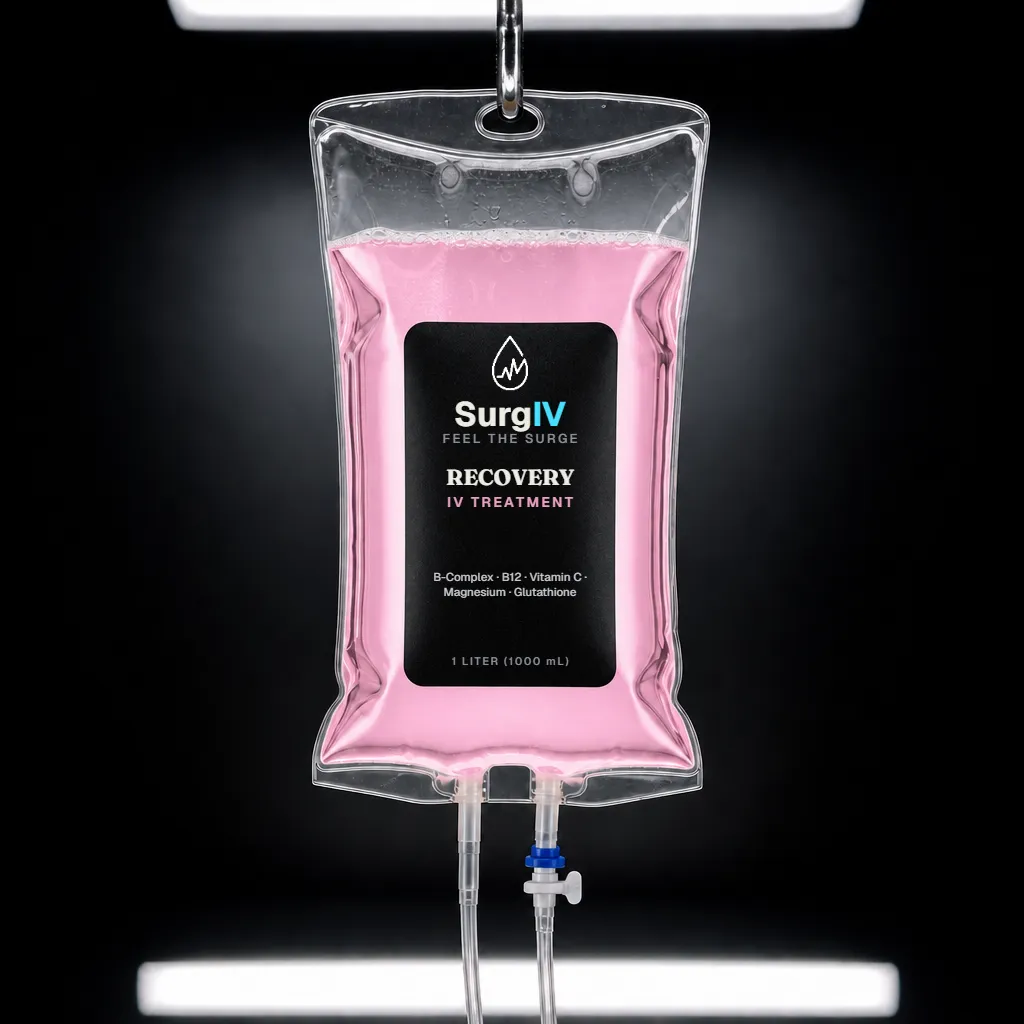
Every decade's ally
Recovery $299
The recovery window shrinks when the deficits are funded. Fund them.
B-Complex · B12 · Vitamin C · Magnesium · Glutathione
The parking lot, one year later
Same three cars, new data: the 55-year-old — now spacing hard days, sleeping like it's programming, dripping after the big weeks — reports Thursday's leg day clearing by Saturday. "Renegotiated the arrangement," he announces, easing into the seat with slightly less diplomacy. The 28-year-old, genuinely: "So it's not over at 40?" The 41-year-old and the 55-year-old, in accidental unison: "It's not over. It's just scheduled."
This article is for general education and is not medical advice. IV therapy at SurgIV is administered by registered nurses under physician-written protocols, with a health screening before your first visit. Talk to your doctor about what is right for you.