
Six weeks after her daughter was born, a client we'll call Alana, 34, sat in the pediatrician's waiting room for the baby's fourth appointment of the month and did the arithmetic that eventually brought her to us. The baby: four appointments, growth charts, a care team. Alana — who had grown, delivered, and was now feeding that baby around the clock: one appointment. Ten minutes. "Everything looks fine. Any questions?" She'd cried in the parking lot after, not from sadness exactly. From the sudden clarity of it: everyone got a recovery plan except the person recovering.
The ledger nobody itemizes
Birth is the largest physical event most bodies ever undergo, and the accounting is stark:
- The pregnancy drawdown. Nine months of the baby taking nutritional priority — iron, folate, calcium, B12, vitamin D stores all drawn down by design. You didn't fail to eat well; the system routes resources to the construction project first.
- The delivery bill. Blood loss (iron again), tissue repair on a surgical scale (C-section or not), and a hormonal cliff that makes adolescence look gradual.
- The breastfeeding budget. 500+ extra calories and significant extra fluids daily — an athlete's metabolic demand, funded from already-emptied stores. Milk production takes priority over maternal reserves; you're last in your own supply line again.
- The rebuild blocker. All of this repair is supposed to run during sleep — the exact resource a newborn schedule shreds into ninety-minute fragments. The construction crew is funded in a currency you can't currently earn.
The baby leaves the hospital with a care plan. The mother leaves with a follow-up in six weeks and a pamphlet.
The line that matters: depletion vs. depression
One paragraph we won't soften: postpartum depletion (the physical ledger above) and postpartum depression overlap, coexist, and get mistaken for each other constantly. Exhaustion, fog and weakness that ease with rest and repletion point at the ledger; persistent hopelessness, disconnection, or thoughts that frighten you point at PPD — which is common, medical, treatable, and exactly what your OB wants to hear about at any hour. The rule is simply both: report everything, treat everything. Fixing the iron while missing the depression fails you; dismissing real depletion as "just baby blues" fails you the other way. You deserve the full diagnostic courtesy the baby gets at every visit.
Funding the rebuild
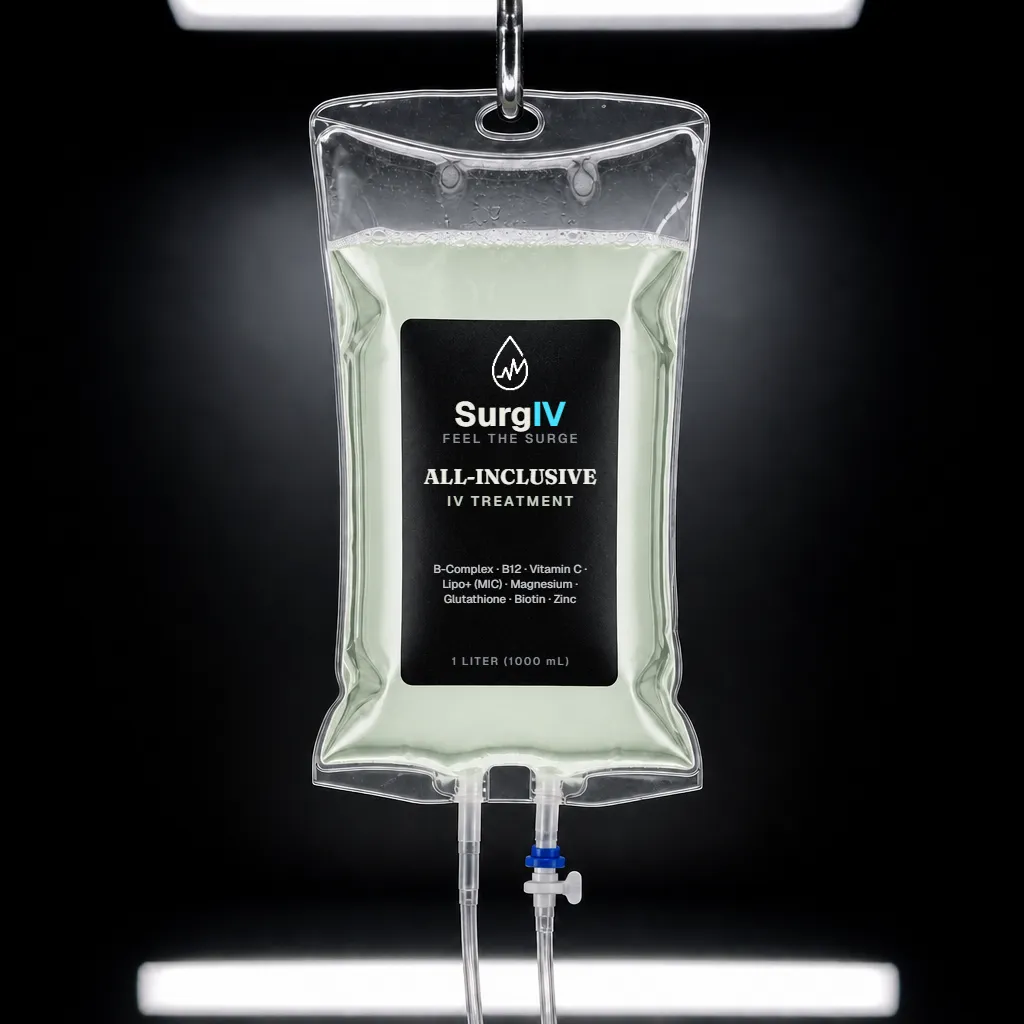
What the recovery actually needs, and how our postpartum members (post-OB-clearance, breastfeeding-screened) structure it: iron status checked by the doctor — the birth's biggest single line item, and a lab, not a guess. Fluids at nursing scale — a glass every feed is the classic anchor; the utilities bill doesn't end at delivery. Real food engineering — the meal train exists because one-handed eating is a genuine constraint; accept every casserole. Sleep in shifts where humanly possible — the one input nothing replaces. And the piece Alana came for: the mother's appointment — the All-Inclusive IV at home, baby in arms, full panel (fluids, B family, C, magnesium) delivered around the nursing schedule — an hour where the person who became everyone's infrastructure gets serviced like it. Partners: booking this for her is the rare gift that's also policy.
The mother's appointment
All-Inclusive $349
Full-panel restoration at home, baby in arms — because leaving isn't an option and depletion isn't a duty.
B-Complex · B12 · Vitamin C · Lipo+ (MIC) · Magnesium · Glutathione · Biotin · Zinc
Alana, at four months
Alana runs a monthly session now — her husband's standing gift order, scheduled against the pediatrician visits with deliberate symmetry — plus the iron her OB found low and fixed. Her review is the one we'd put on the pamphlet if we wrote it: "The baby has a team. Turns out the mother is allowed one too." Fourteen appointments for the baby was never the problem. One for you was.
This article is for general education and is not medical advice. IV therapy at SurgIV is administered by registered nurses under physician-written protocols, with a health screening before your first visit. Talk to your doctor about what is right for you.