
The cooler at every Palm Beach gas station tells the story of the most successful product drift in beverage history: neon bottles engineered in 1965 for University of Florida football practice, now purchased at 9 AM by hungover men in sunglasses, at noon by desk workers who haven't sweated since spin class, and at 6 PM by parents medicating a kid's stomach bug. A man we'll call Pete, 44, was the 9 AM archetype — two orange Gatorades, every rough Sunday, a ritual inherited from his father — until the morning he read the label in the parking lot and performed the double-take that led him here: "Fifty-six grams of sugar?? I'm hungover, not running a marathon."
Correct, Pete. And that distinction — hungover versus marathon — is the entire comparison.
What the bottle was built for (and it's genuinely good at it)
The original formula solved a real problem: athletes in prolonged exertion lose fluid and sodium while burning carbohydrate — so the drink delivers all three at once, mid-activity, when muscles vacuum up the sugar as fuel and the modest sodium supports ongoing sweat. For that job — the long run, the 36-hole day, the two-hour ride — the design remains sound, and we recommend it in exactly those articles. The sports drink is a fueling product that happens to hydrate. Its entire drift problem comes from being used as a recovery product that happens to contain sugar.
"I'm hungover, not running a marathon." — Pete, discovering the job description on the label
The off-label math
Run the bottle against its common off-label uses and the mismatches stack: the hangover — Pete's 56 grams of sugar hit a body burning nothing, adding a glucose ride to the shakes already in progress, while the sodium content undershoots what real repletion wants (it was calibrated for someone still sweating, not someone multi-liters down); the stomach bug — where excess sugar actively worsens things and the pediatric aisle's formula beats it decisively; the desk habit — liquid candy with an electrolyte halo. In every off-label case, the bottle isn't bad — it's miscast: a fueling formula performing repletion, like hiring a sprinter to move furniture.
The honest hierarchy
Assembled from this whole series: mid-exercise — the sports drink, doing its actual job. Daily maintenance — water, food, maybe a low-sugar electrolyte packet. Real repletion, oral route — ORS-grade options (Pedialyte-tier ratios, minimal sugar), sipped on schedule. Repletion past the oral route's walls — the multi-liter deficit on a deadline, the barricaded stomach — the full liter delivered past every limit, which is where our lane begins and every bottle's ends. Pete's Sunday ritual, upgraded accordingly: the drip for the real casualties, zero-sugar electrolytes for the minor ones, and the orange Gatorade returned to its birthright — his Saturday golf bag, mid-round, where it's been the right answer since 1965.
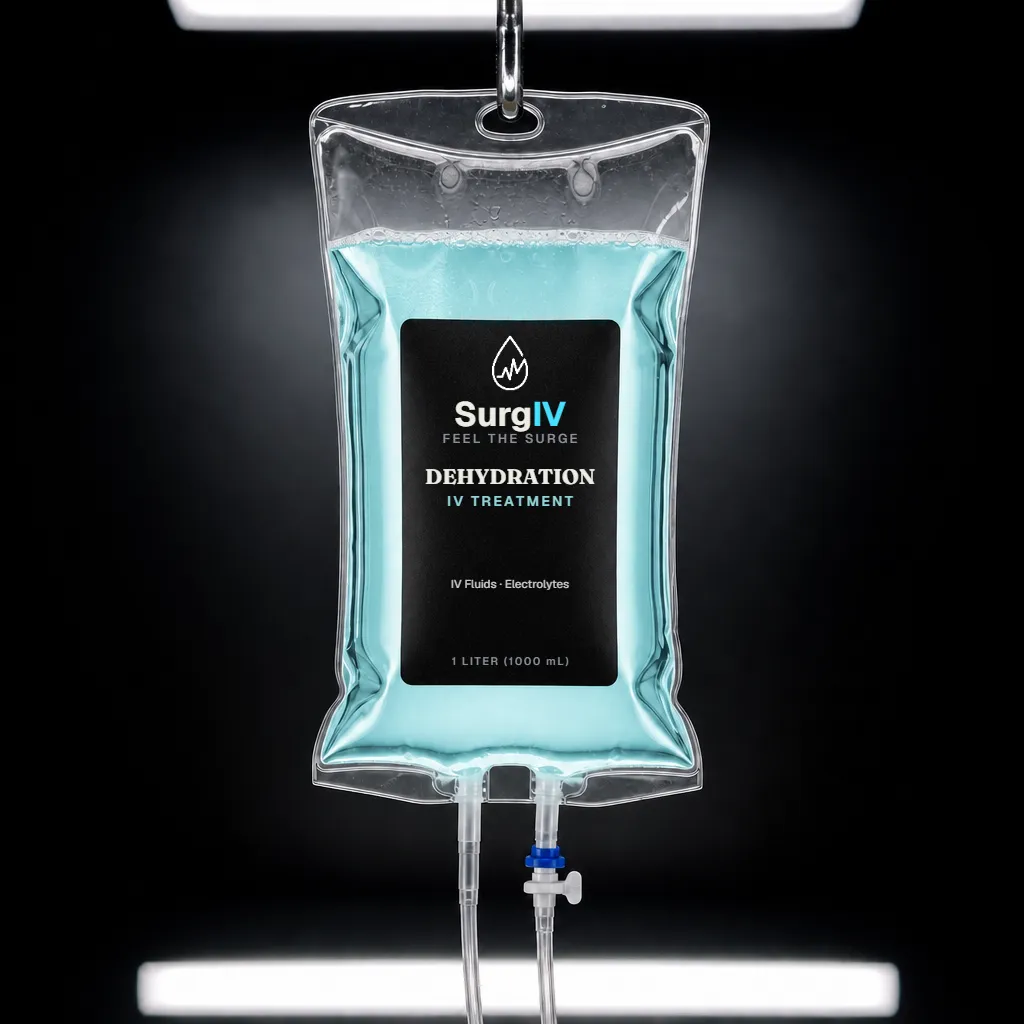
Beyond the bottle's job description
Dehydration $199
A full liter with balanced electrolytes, no sugar payload — for the deficits the bottle can't touch.
IV Fluids · Electrolytes
The cooler, decoded
The neon bottle isn't a scam — it's a specialist that got drafted into general practice by great marketing and habit. Match it to its job description and it performs; ask it to fix your Sunday and you're drinking a sprinter's lunch on a moving day. Pete's father's ritual survives in amended form, as Pete now explains at tee times with a convert's zeal: "During the round, the orange one. After the damage, the nurse. Dad had the right instinct and the wrong aisle."
This article is for general education and is not medical advice. IV therapy at SurgIV is administered by registered nurses under physician-written protocols, with a health screening before your first visit. Talk to your doctor about what is right for you.