
3:05 PM, a Tuesday, a fourth-floor office in West Palm. A woman we'll call Whitney, 34, paralegal, mid-deposition-prep, feels it start again: the flutter under her left eye, tap-tap-tap, like a moth trapped in her face. Day nine. She has asked four coworkers to look at it; all four have said, with infuriating sincerity, "I don't see anything." Her search history has escalated accordingly: "eye twitch causes" → "eye twitch two weeks" → "eye twitch neurological disease." Whitney is three tabs from a self-diagnosis. Her actual condition, for the record: a firm's deadline season, a six-coffee Tuesday, and five hours of sleep. The moth is a memo.
What the flutter actually is
Eyelid myokymia — spontaneous mini-contractions in the fibers of the muscle that runs your lid, driven by small nerves firing without orders. It is benign, extremely common, and engineered by nature for maximum psychological torment: vivid to you, invisible to witnesses, and immune to willpower. And its causes are so consistent that clinicians recite them as a quartet: fatigue (the number-one driver, no contest), caffeine (excitable nerves, made more so), stress (cortisol holds the nervous system on a hair trigger), and screen strain. Whitney is currently running all four at redline simultaneously. The moth didn't choose her randomly.
The eye twitch is the body's smallest warning light — too minor to stop you, too annoying to ignore. That's not a design flaw. That's the design.
The fifth member: minerals
Underneath the quartet sits the frequently-implicated fifth: magnesium status. Magnesium is the nervous system's damper — it regulates nerve excitability, the exact dial myokymia turns up — and it's the mineral modern life depletes most reliably: sweat, alcohol, stress, and refined diets all spend it, almost nobody restocks it, and its shortfall shows up precisely in the twitchy-muscle department, from eyelids to the 3 AM calf. A deadline-season paralegal in Florida, running on cortisol and cold brew, is close to a case study in magnesium spend-down. The twitch, the cramps, and the wired-tired feeling are frequently one story told by three muscles.
Ending it — and the short list that isn't this
The protocol: two or three genuinely full nights of sleep (this alone ends most twitches — it's feedback, not disease), halve the caffeine for one week, run the 20-20-20 screen rule through deadline season, and restock the fifth member — dietary magnesium, or the clinical version when the season's spend-down runs deep. The neurologist's short list, honestly stated: a twitch that spreads beyond the lid to the face, pulls the eye fully shut, persists for months, or arrives with weakness or drooping. The garden flutter that haunts a bad fortnight is not on that list — it's on the memo pile.
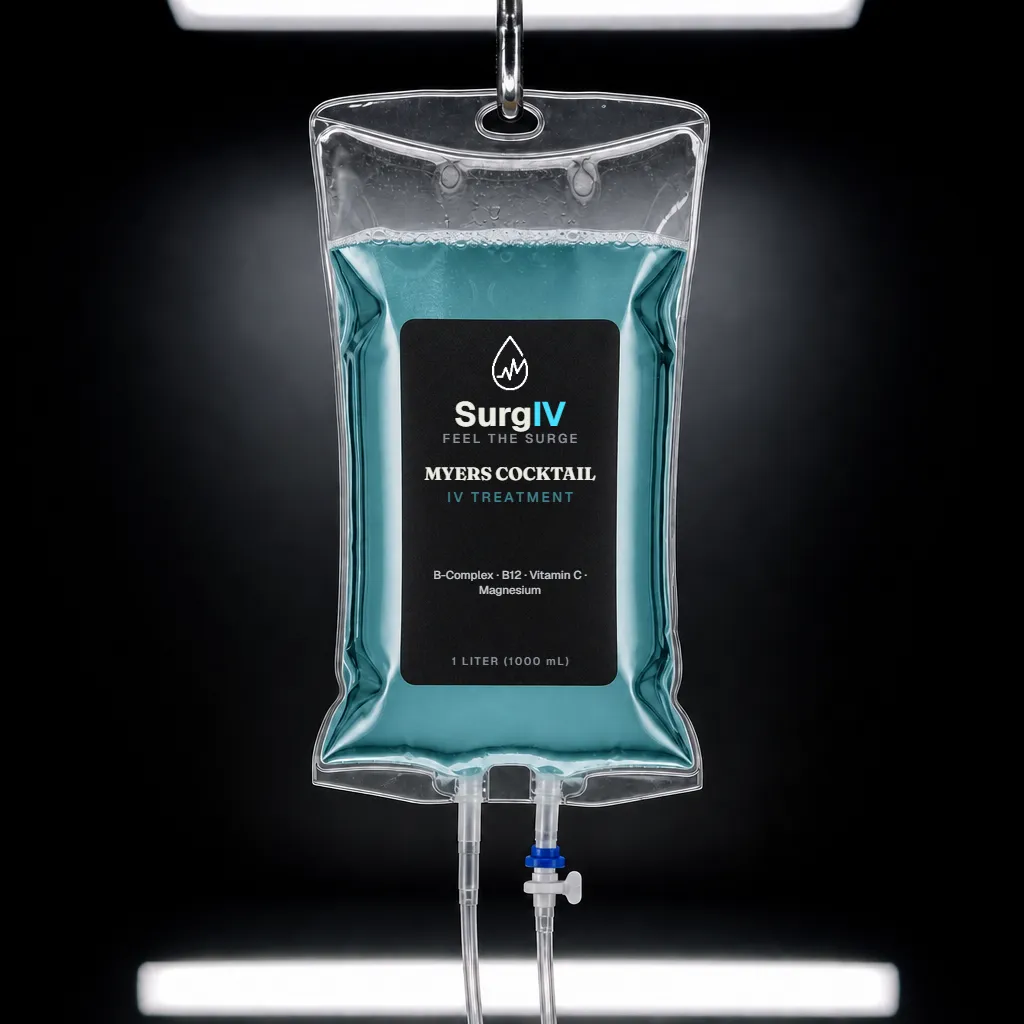
The quartet, addressed
Myers Cocktail $249
Magnesium and B vitamins for the depleted; the sleep is on you.
B-Complex · B12 · Vitamin C · Magnesium
Whitney, moth released
Deposition filed Friday; she slept nine hours twice, cut to two coffees, and booked the Myers' she'd been deferring since spring. The twitch quit on day three of the new regime — as they nearly always do — and her closing argument, delivered to the four unhelpful coworkers: "It was never a disease. It was an invoice. Smallest font on the bill, but an invoice." Pay the sleep first. The moth reads receipts.
This article is for general education and is not medical advice. IV therapy at SurgIV is administered by registered nurses under physician-written protocols, with a health screening before your first visit. Talk to your doctor about what is right for you.